Honda Civic Type R Wheel Offset Guide — FK8 & FL5
Wheel offset explained for FK8 and FL5 Civic Type R owners — what the numbers mean, how they affect fitment and clearance, and what to check before buying.
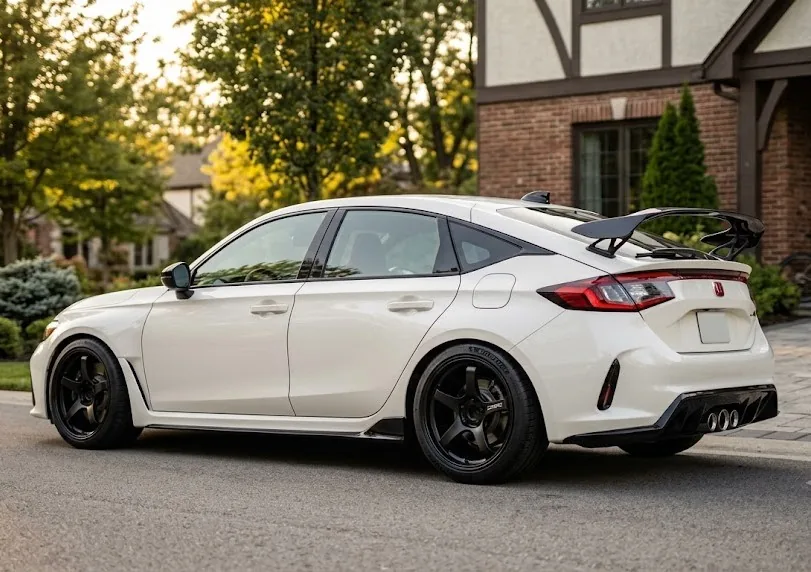
Offset is one of the numbers that can make a wheel look perfect in a listing and completely wrong on the car. On the Type R, treat ET as one part of a fitment equation: wheel width, tire shape, brake clearance, suspension height and alignment all matter.
What ET Actually Means
ET is the wheel's offset in millimeters. A higher positive offset places the mounting face farther toward the outside face of the wheel, pulling the wheel inward on the car. A lower positive offset generally moves the wheel outward. The change is predictable mathematically, but the clearance result is not determined by offset alone.
FK8 and FL5 Factory Baselines
| FK8 | FL5 | |
|---|---|---|
| Factory wheel | 20x8.5 | 19x9.5 |
| Factory tire | 245/30ZR20 | 265/30ZR19 |
| Factory offset reference | ET60 | ET60 |
| PCD | 5x120 | 5x120 |
The FL5 specifications above are confirmed by Honda. The FK8 factory wheel/tire and ET60 figures are supported by established fitment references; for an aftermarket purchase, use the wheel manufacturer's application data rather than assuming the factory number guarantees clearance.
What Happens When You Change ET?
Imagine replacing a 9.5-inch ET60 wheel with the same width at ET45. The mounting face moves 15 mm inward relative to the wheel, so the wheel's outer face moves roughly 15 mm farther outward as well. The inner clearance changes by the same amount in the opposite direction. That is the simple part.
The complicated part is what the tire does. A wider tire, a square shoulder, additional negative camber or a lowered ride height can turn that 15 mm into either a perfectly usable setup or a rubbing problem.
Inner vs Outer Clearance
| Check | What can cause trouble |
|---|---|
| Inner barrel/spokes | Brake caliper, strut or suspension components |
| Outer sidewall | Fender lip, liner and bodywork under compression |
| Full steering lock | Forward/rear liner clearance on the front axle |
| Suspension compression | Wheel/tire movement toward the arch |
Spacers: Useful, But Not Free
A spacer effectively reduces the wheel's ET by the spacer thickness. That can solve an inner clearance problem, but it also moves the wheel outward, reducing fender clearance and changing steering geometry. If you use spacers, use a properly hub-centric system and make sure the fastener engagement remains appropriate.
Do Not Shop by “Safe Offset” Alone
A statement such as “ET40 fits the FL5” is incomplete unless it also tells you the wheel width, tire size, tire model, suspension height and brake package. That is why our recommendation is to record the complete fitment rather than a single ET number.
Practical Offset Workflow
- Start with the factory wheel dimensions.
- Choose the desired wheel width.
- Choose the tire and confirm its approved rim width.
- Check brake clearance for the actual wheel model.
- Calculate the change in inner and outer position.
- Check full-lock and compression clearance.
- Only then decide whether spacers or alignment changes are appropriate.
A Simple ET Calculation
Suppose you have a 9.5-inch ET60 wheel and compare it with a 9.5-inch ET45 wheel. Because the width is unchanged, the 15 mm ET difference shifts the wheel outward by approximately 15 mm and gives you approximately 15 mm more inner clearance at the wheel position. That is the cleanest offset comparison.
Now change the width too. If you move from 9.5 inches to 10 inches, you add 12.7 mm of total width. Half of that is roughly 6.35 mm on either side before the ET change is considered. This is why width and ET should always be evaluated together.
Offset and Steering Feel
Changing wheel position can change scrub radius and steering behavior. You may notice more kickback over rough pavement or a different steering weight, particularly with a large spacer or a substantial move outward. That does not mean every lower-ET wheel makes a Type R unpleasant; it means aggressive geometry changes should be made deliberately rather than purely for stance.
Why the Factory ET Is a Baseline, Not a Target You Must Copy
The factory FK8 and FL5 packages use high positive offset, but aftermarket wheels can use lower ET values and still work. The reason to start from ET60 is simply that it gives you a known reference point. Once you choose a width, you can calculate how far the new wheel moves relative to that baseline and then check the physical clearances.
Fitment Notes for Lowered Cars
On a lowered Type R, measure at static ride height and think about what happens during compression. Negative camber can pull the top of the tire inward, while suspension compression can move the tire upward and inward relative to the arch. The exact result depends on the suspension setup. Do not use a static ruler measurement as proof that a wheel will never rub.
Sources and Fitment Notes
The factory Type R wheel/tire baselines used here are drawn from Honda documentation and cross-checked against wheel-fitment references. Aftermarket offset recommendations are presented as examples, not guarantees; wheel width, tire construction, spoke profile, brakes and suspension setup can change the result.
Honda Civic Type R specifications
Frequently Asked Questions
Does lower ET always mean more rubbing? No, but it moves the wheel outward relative to the same-width/hardware baseline, so outer clearance becomes more important.
Can the same ET fit two different wheels? Yes, because spoke shape, barrel profile and wheel width can differ even when ET is identical.
For the underlying geometry, see Wheel Offset Explained. For Type R wheel width and tire pairing, see Civic Type R Wheel Width Explained.
Spacer hardware: For the next step, see our 10th-gen Civic extended wheel studs and 5mm spacer guide.
What to Read Next
If you're working through this modification, these guides cover the next decisions that usually come up.
Worked example: changing width and ET together
Suppose your current wheel is narrower and your new wheel is wider. If the new wheel also has a lower positive ET, both changes push the outer edge outward while the added width also consumes some inner clearance. This is why a simple statement such as “the ET is only a few millimetres different” can be misleading.
Calculate the movement of each edge before ordering. Then treat the calculation as a screening tool, not proof of fitment. Spoke shape, tire section width and brake clearance still need separate verification.
Why forum fitment numbers conflict
Owners often describe fitment using only ET because it is easy to quote. The missing information is usually wheel width, tire model, suspension height and alignment. Two owners can report different results with the same ET because they are not running the same complete package.
Keep a fitment record
When you find a setup that works, record the exact wheel part number, width, ET and tire model. That record is more useful for future changes than a photo or a short forum comment.
Offset Should Be Compared With Wheel Width
ET by itself does not tell you where the outer lip will sit. A wider wheel at the same offset moves outward as well as inward, while a different offset changes both positions. Always compare complete wheel specifications.
Use the stock wheel as the reference
Calculate how far the proposed wheel moves toward the strut and toward the fender. Then consider the tire's actual section width and tread shape. This is especially important when clearance is already tight.
Do not solve every clearance issue with a spacer
A spacer can create additional inner clearance, but it also moves the wheel outward and can introduce fender clearance or wheel-bearing considerations. Treat it as one engineering choice rather than an automatic fix.