Why is My Exhaust Droning at Highway Speeds — and How to Fix It
Exhaust drone is the low, repeating boom that seems to lock onto one engine speed and follow you around the cabin. If your new exhaust sounds great under acceleration but becomes tiring on the motorway, you're probably dealing with resonance rather than simply 'too much volume.'
What Exhaust Drone Actually Is
Exhaust drone is a specific low frequency sound — typically between 100–200 Hz — that resonates through your car's cabin at a particular engine RPM range. If you're choosing between exhaust brands and trying to avoid drone from the start, our Flowmaster vs Borla comparison covers exactly which designs are most and least prone to this problem. It usually appears at steady highway cruising speeds — around 60–80 mph — where the engine sits at a consistent RPM for extended periods.
It is different from normal exhaust note. A good exhaust sounds aggressive under acceleration and then settles into a pleasant tone at cruise. Drone is when that tone becomes an uncomfortable, fatiguing vibration that fills the cabin and makes long highway drives unbearable.
That distinction trips up a lot of people shopping for a new exhaust. They assume going with a quieter system fixes drone, and sometimes it does, but plenty of quiet systems still drone because the issue is frequency, not decibels. You can have a relatively mild exhaust that still resonates badly at 70 mph, and you can have a loud, aggressive system that's perfectly comfortable on the highway because the resonant frequency falls outside the range your cabin amplifies.
Important to know: Some drone is inevitable with aggressive aftermarket exhausts. The goal is to reduce it to a tolerable level — not always to eliminate it completely. Aggressive systems can be more difficult to make quiet at cruise. If highway comfort is the priority, compare systems for your exact vehicle and look for documented or owner-reported results at steady cruising speed rather than assuming any system will be completely drone-free.
Cause 1 — Muffler Resonance Frequency Matching the Cabin
Every exhaust has resonant frequencies. The problem starts when the exhaust's strongest frequency lines up with a frequency the car's cabin naturally amplifies. That is why drone can be almost absent at 2,000 rpm and suddenly become obvious at 2,400 rpm, then disappear again as engine speed changes.
The useful clue is repeatability. If the boom appears at a narrow RPM band and changes when you accelerate through it, resonance is a much better suspect than a loose part.
Cause 2 — No Resonator in the System
The resonator is not just a device that makes the exhaust quieter. It is there to shape and cancel parts of the sound before they reach the muffler and cabin. Removing it can make an exhaust noticeably louder and can also make a previously tolerable system develop a narrow-band boom.
- If you removed the resonator, restoring it is the cleanest first test.
- If the system has room, a quality inline resonator can change the offending frequency without replacing the entire exhaust.
- Do not assume a bigger muffler is automatically the answer; the location and tuning of the resonator matter too.
Cause 3 — Exhaust Pipe Diameter Too Large
Pipe diameter can affect gas velocity and the sound spectrum, but it is not a universal drone formula. A large pipe is not automatically the cause of drone, and a smaller pipe is not automatically the cure. Vehicle-specific design, resonator placement, muffler volume and engine speed all interact.
So before replacing a system because someone told you 'three inches is too big,' identify the actual symptom and inspect the rest of the system first. If the manufacturer designed the system specifically for the car, the pipe diameter alone is not enough evidence that it is wrong.
Cause 4 — Exhaust Contacting the Chassis or Body
A physical contact problem sounds different from normal resonance. You may hear a metallic buzz, tap or vibration over bumps, or the noise may change when the engine moves under load. Check the exhaust cold and look for shiny witness marks, tight clearances, damaged hangers or a pipe sitting against a heat shield.
- Check every hanger and rubber isolator.
- Look for metal-to-metal contact around heat shields and the chassis.
- Check tip and muffler clearance after the car is back on the ground.
- If the sound appeared immediately after an installation, inspect the installation before changing parts.
All the Fixes Ranked by Effectiveness
1. Fix physical contact first
If the exhaust is touching the car, fix that before chasing acoustic solutions. No resonator can make a pipe-to-body contact disappear.
2. Restore or add the appropriate resonator
This is often the most sensible next step when the exhaust is simply resonating at cruise.
3. Reconsider the muffler/system design
If the system was designed primarily for maximum volume, you may be fighting the hardware. At that point, changing to a better-engineered vehicle-specific system can be cheaper than stacking fixes onto a bad starting point.
4. Reduce cabin transmission
Sound deadening can reduce what you hear, but it treats the symptom. Use it when the exhaust itself is acceptable and the cabin needs more isolation, not as the first fix for a loose or poorly aligned system.
Why Some Brands Drone Less Than Others
Good exhaust systems use resonators, muffler volumes, chamber geometry and sometimes tuned side branches to control specific frequencies. That engineering is why two systems with similar pipe diameters can behave very differently on the same car.
When comparing brands, look for actual information about resonator strategy and vehicle-specific development rather than only phrases such as 'race sound' or 'maximum flow.' For example, AWE publishes specific drone-cancellation technology for its Touring Type R systems, while its Track versions deliberately remove that extra frequency-control element for a louder result.
And if you're evaluating a specific exhaust, search for the exact car, exact system and the word 'drone' together. A video of a cold-start rev in an empty parking lot is entertainment; a highway recording at steady RPM is useful evidence.
A Diagnostic Process That Saves Parts
Start by identifying the exact speed and engine rpm where the drone is strongest. If the sound appears only in a narrow band, resonance is a more useful starting point than simply reducing overall exhaust volume.
Check for mechanical causes
Inspect hangers, clamps, joints, heat shields, and clearances around the body. A contact point can transfer vibration into the cabin and make a correctly functioning exhaust sound much worse than it should.
Change one variable at a time
If you add a resonator, muffler, or other component, keep track of the change. Making several modifications at once makes it difficult to know which part solved the problem and can turn a simple fix into an expensive guessing game.
for the F150-specific version of this problem, our F150 drone fix guide covers the SuperCrew vs SuperCab differences that affect which solution works.
our Silverado-specific drone fix guide covers the AFM disabler solution that most Silverado owners need alongside any exhaust system.
How to Choose a Resonator for Drone Control
A resonator is not simply a “quieter muffler.” Its job is to influence the frequencies that make the exhaust sound harsh or intrusive. Diameter, length, internal design and placement all matter, so a resonator that works well on one system is not guaranteed to solve another system's drone.
For a street car, start with the least invasive fix that addresses the actual cause. If the exhaust is physically contacting the chassis, adding a resonator will not repair the contact. If the system is correctly mounted but has a narrow, repeatable drone band, resonator or muffler changes become much more relevant.
Type R Owners: Don't Judge a System Only by Cold Start
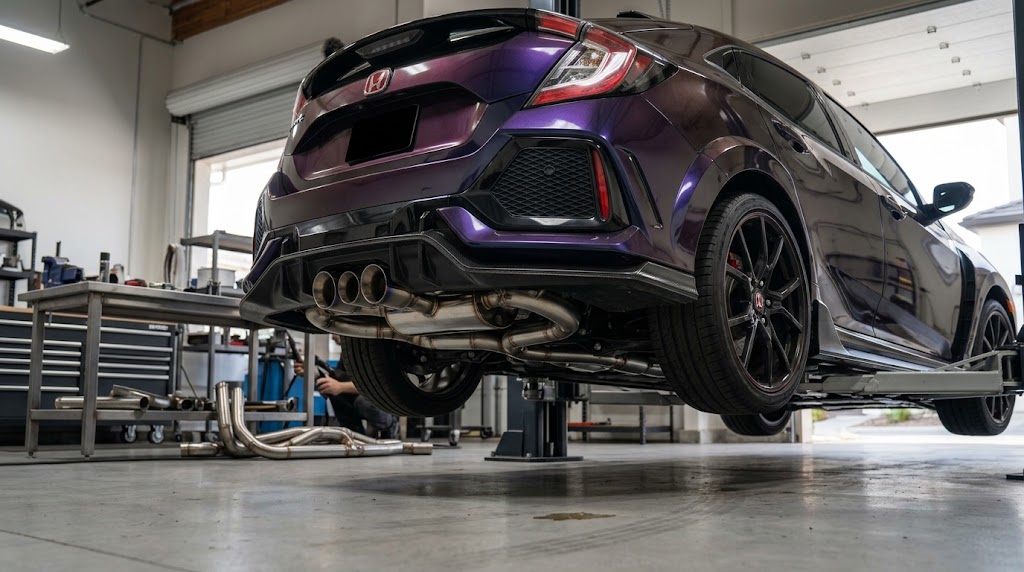
The cabin experience at cruising RPM is more important than how an exhaust sounds for the first few seconds after startup. A system can sound excellent under acceleration and still become tiring at steady highway speed. This is especially important for owners comparing the FK8 exhaust options or the FL5 exhaust options.
How to Diagnose Drone Before Buying Parts
Start by identifying the exact speed and engine RPM where the unwanted sound appears. A drone that occurs only in one narrow cruising range usually points toward resonance, while a vibration that changes when the car moves over bumps can indicate contact or mounting issues. Having that distinction clear prevents an expensive parts-swap exercise.
Next, inspect the exhaust cold and safely lifted. Look for polished or scraped areas where a pipe, muffler or heat shield may be touching the chassis. Check hangers for damage and confirm that the system is centered correctly. Exhaust components expand as they heat, so a system that looks acceptable cold can still make contact at operating temperature.
Resonator Diameter: Match the Part to the System
The supplied Vibrant options illustrate why diameter matters. A 2.5-inch resonator and a 3-inch resonator are not interchangeable simply because both are designed to reduce unwanted exhaust frequencies. The part needs to match the pipe diameter and the available installation space. A shop may also need to account for inlet and outlet configuration, overall length and how much pipe must be removed to install the component.
Do not assume that a larger resonator automatically means a quieter or better result. The correct part depends on the exhaust system's design and the frequency that is creating the problem.
When a Complete Exhaust Change Makes More Sense
If the current system has an aggressive muffler, minimal resonation and a drone band that remains after installation problems are corrected, replacing the entire cat-back can be more predictable than repeatedly modifying individual sections. This is where comparing complete systems such as the AWE FK8 and FL5 options can make sense.
The goal for a daily-driven Type R should be a system that sounds purposeful under acceleration but remains comfortable at steady highway speed. Listen for cruising behaviour, not just cold-start volume or a short exterior clip. Cabin resonance is often much more noticeable from the driver's seat than it sounds from outside the car.
Drone Fix Checklist
- Identify the exact RPM and road speed where the drone occurs.
- Inspect for chassis, heat-shield and bumper contact.
- Check exhaust hangers and system alignment.
- Confirm the pipe diameter before selecting a resonator.
- Use a resonator or muffler change only when resonance is actually the cause.
- Judge the finished system from inside the cabin during steady cruising.
Drone vs Rasp vs Exhaust Vibration
Not every unpleasant exhaust sound is drone. Drone is usually a sustained, booming or low-frequency resonance that becomes especially noticeable at a fairly steady engine speed. Rasp is a sharper, harsher metallic sound, often associated with certain pipe, resonator and muffler combinations. A vibration or rattle can instead come from physical contact, a loose hanger, heat shield or another component touching the body. For a sound-by-sound diagnosis, use the drone vs rasp vs resonance guide before changing exhaust parts.
This distinction matters because the fixes are different. Adding a random muffler may not solve a contact problem, and changing a resonator will not necessarily cure a loose heat shield. If the sound changes dramatically when the engine speed changes but the vehicle is stationary, note the RPM and sound character. If it appears only under load or only while the car is moving, inspect the system for movement and contact as well.
Use RPM to Describe the Problem Before Buying Parts
Write down approximately where the sound occurs: for example, during a steady highway cruise, during acceleration, or across a narrow RPM band. Also note whether it occurs in one gear or several. This gives an exhaust shop or installer something more useful to work with than simply saying that the exhaust is "too loud." Resonance is strongly dependent on the complete system, cabin and engine operating condition, so a part that works on one vehicle is not guaranteed to behave identically on another.
When a Resonator Is the Better First Change
If the exhaust system is otherwise mechanically sound and the problem is a repeatable low-frequency boom, a properly selected resonator can be a more targeted intervention than replacing the entire exhaust. The important variables include the resonator's construction, dimensions, placement and compatibility with the rest of the system. There is no universal resonator size that eliminates drone from every engine and exhaust combination.
For vehicle-specific cases, use the F-150 exhaust-drone guide or Silverado exhaust-drone guide. For system-level choices, compare cat-back vs axle-back exhaust before replacing parts simply because a system is louder.
Frequently Asked Questions
What is the first thing to check when an exhaust drones?
Check for physical contact and installation issues first, then identify the exact RPM range where the drone occurs.
Will adding a resonator always fix drone?
No. It can be very effective when the resonance is being caused by the system's frequency behaviour, but a physical contact problem or fundamentally poor muffler design needs a different fix.
Is exhaust drone harmful?
Normal acoustic drone is primarily a comfort problem. A metallic rattle or vibration can indicate a physical issue, so do not dismiss a new mechanical noise as "just drone."
Can exhaust tips fix drone?
No. Tips can alter appearance and may slightly change the sound character, but they are not a reliable cure for cabin resonance.
What causes exhaust drone? Drone is resonance at specific frequencies — usually 1,500-2,500 RPM — where the exhaust system's sound waves amplify rather than cancel. Single-chamber mufflers and systems without resonators are most prone to drone.
How do I fix exhaust drone without replacing the exhaust? A resonator can be added to the exhaust system to cancel the frequencies causing drone. Exhaust tips alone do not fix drone. A Dynamat-style acoustic damper on the driveshaft tunnel can reduce how much drone transmits into the cabin.
Does drone get better over time? Sometimes slightly, as packing material in the muffler settles. But significant drone from a poorly designed system rarely improves meaningfully on its own — the fix is a resonator or muffler change.
Which mufflers have the least drone? Borla S-Type, Magnaflow straight-through designs, and Corsa exhaust systems consistently rank lowest for drone. Single-chamber designs like Flowmaster Super 44 rank highest for drone risk.
Is drone bad for my engine? Drone is uncomfortable but not harmful to the engine itself. It is purely an acoustic issue affecting cabin comfort, not a mechanical problem.
Civic Type R Exhaust Guide · FK8 Exhaust Guide · FL5 Exhaust Guide