Civic Type R Suspension Guide — Coilovers and Springs for FK8
The FK8 Type R comes with one of the best factory suspension setups on any front-wheel-drive car. Understanding what it already does well is the starting point for any suspension upgrade decision.
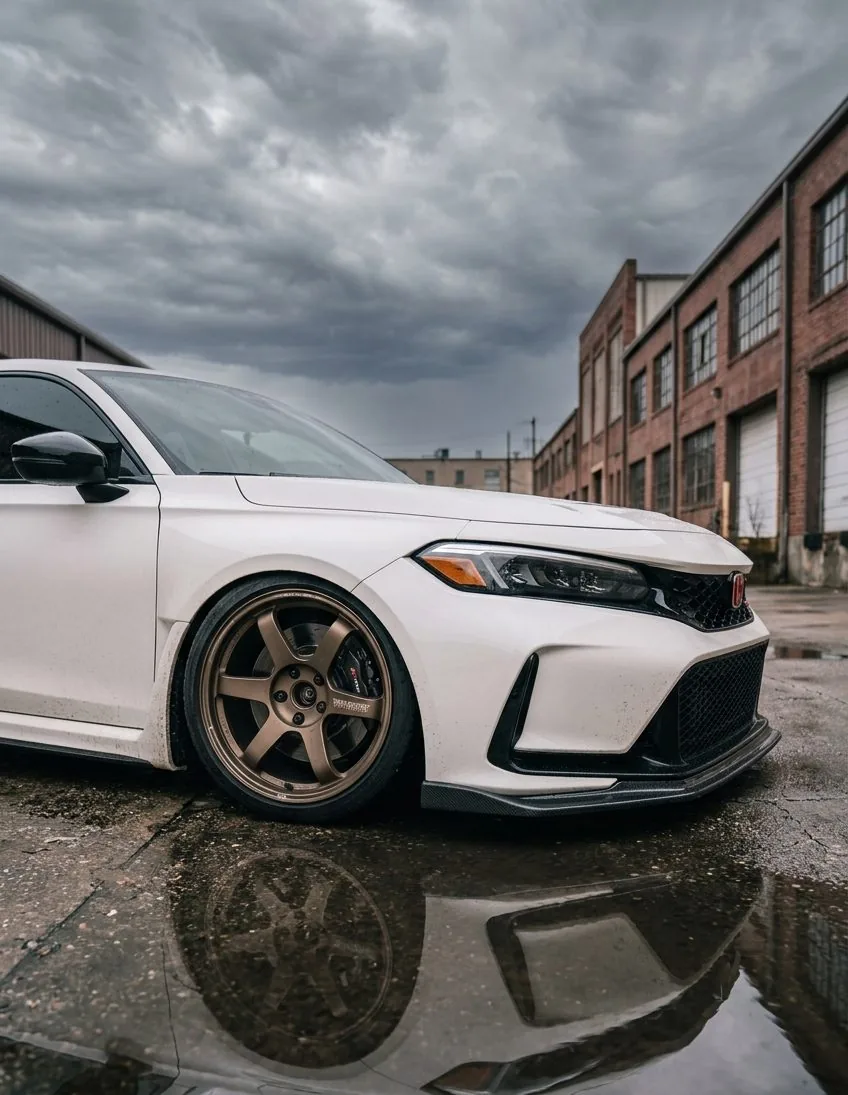
Start With What Honda Already Gave the Type R
The Civic Type R is unusual because the starting point is already a serious performance suspension. The FK8 and FL5 use a dual-axis MacPherson-strut front suspension, a multi-link rear suspension and electronically controlled adaptive dampers. Honda designed that combination to give the car sharp steering and strong body control without turning every road into a test of your spine.
That matters when choosing modifications. A Type R does not need suspension parts simply because the car is “too soft.” Usually, the better question is what you want the car to do differently. More steering response? A lower stance? More freedom to choose spring and damping rates? Better control on track? Those goals can lead to completely different answers.
| Your goal | Usually the first place to look | Why |
|---|---|---|
| Lower the car without rebuilding the suspension | Vehicle-specific lowering springs | Simple change while retaining the factory damper system |
| Choose your own ride height and damping | Quality coilovers | More control over the suspension package |
| More rotation or balance tuning | Rear sway bar and alignment | Can change handling balance without replacing the whole suspension |
| Track-focused setup | Coilovers, alignment and tires as a system | The parts need to work together rather than being selected individually |
Springs, Coilovers or Neither?
If you enjoy the Type R as a daily driver and mainly want a slightly lower stance, a vehicle-specific spring can be the more sensible modification. Eibach, for example, lists dedicated Pro-Kit applications for both the 2017–2021 FK8 and 2022–2026 FL5, with the FL5 application specifically described as tested with factory dampers. That is very different from choosing a generic spring because the advertised drop looks good.
Coilovers make more sense when the ability to change ride height and damping is part of the reason you are modifying the car. They are not automatically better. A poorly matched coilover with excessive spring rate or very little usable travel can make a Type R less enjoyable on rough pavement even if it looks more serious in the driveway.
There is also a factory-feature tradeoff. The Type R's adaptive damper system is part of the car's character. A conventional coilover does not automatically reproduce that factory behavior, and some aftermarket systems require additional hardware or electronics if you want to avoid warning lights or retain some form of damping control. Treat that as part of the purchase decision, not an afterthought.
What a Good Daily-Driven Type R Setup Looks Like
For a road car, usable suspension travel is more important than an impressive number on the height-adjustment collar. You want the damper to have room to control the spring without constantly running into the bump stop. You also want enough clearance for your tires, wheel offset and normal road conditions.
A good street setup should feel controlled rather than simply hard. On a smooth road, it should settle quickly after a compression or direction change. On broken pavement, it should still allow the tire to follow the road instead of skipping across it. If the car becomes tiring after an hour of commuting, the setup is not “more performance” just because the body moves less.
Top mounts deserve the same thought. A spherical or pillowball mount can make steering inputs feel more immediate and can provide useful camber adjustment, but it also transmits more small vibration and mechanical sound than a rubber-isolated mount. On paving blocks or sharp expansion joints, the difference can be a more pronounced solid tap or thud. A repeated loud clunk or metallic knock is not something to dismiss as normal NVH; it deserves inspection.
What Each Suspension Part Actually Changes
Springs mainly change support and ride height. They are the simplest way to alter the stance while keeping the factory damper architecture, provided the spring is designed for the vehicle.
Coilovers change both spring and damper. That gives you a matched aftermarket package and, depending on the kit, control over height and damping. The tradeoff is more complexity and the possibility of losing some factory features.
Sway bars change the balance of roll stiffness between the axles. They are a different tool from a coilover: a sway bar can change how the car rotates without changing the basic spring/damper package.
Top mounts affect isolation and, on some designs, camber adjustment. Rubber is quieter; spherical mounts are more direct. Neither is automatically “better” for every Type R.
How to Tell Whether a Suspension Upgrade Is Actually Working
Do not judge the setup while standing beside the car. Drive the same route before and after the change. Pay attention to three things: how quickly the car settles after a bump, whether the tires stay composed over rough pavement, and whether the steering remains predictable when the road surface changes mid-corner.
If the car is simply harder to compress when you push on the fender, that tells you very little. A useful suspension improvement is something you can feel while driving: less unnecessary movement, better control and a more consistent response—not just a stiffer sensation.
FK8 vs FL5: The Decision Changes With the Chassis
The FK8 and FL5 share the Type R philosophy, but they are not interchangeable platforms for aftermarket suspension. Always use the manufacturer's application listing and part number for the exact generation.
For the FL5, Honda lists a 19 × 9.5J wheel with a 265/30ZR19 tire and an adaptive damper system. That combination leaves relatively little room for careless changes in ride height or wheel/tire fitment. The FK8 has its own factory wheel, tire and suspension specifications, so it should be treated as its own application rather than a slightly older version of the FL5.
For either car, think about the whole system: spring, damper, top mount, wheel, tire and alignment. Changing one piece can alter what the other pieces have to do.
Alignment Is Part of the Suspension Upgrade
Any meaningful ride-height change should be followed by an alignment. Lowering can change camber and toe, and those changes can affect both steering behavior and tire wear. The correct target is not automatically “as much negative camber as possible.” For a street car, the useful target is a stable alignment that suits the tire, road use and desired handling balance.
After installation, let the suspension settle according to the manufacturer's procedure, check ride height on level ground and then align the car. If the steering wheel is off-center, the car pulls, or the front and rear toe values are not where they should be, do not try to cure it by changing damper clicks.
Street, Canyon and Track: Three Different Setups
| Use | Prioritize | Avoid |
|---|---|---|
| Daily / rough roads | Travel, moderate rates, good damping, rubber isolation | Maximum drop and aggressive track rates |
| Daily + canyon drives | Controlled damping, sensible ride height, alignment and tire grip | Making the car stiff just to make it feel “race car” |
| Track days | Spring/damper tuning, alignment range, tires and repeatability | Choosing parts by appearance alone |
The biggest mistake is building the third setup when you actually need the first one. A track-oriented suspension can be excellent at a circuit and frustrating on patched city roads. The best Type R setup is the one that matches how the car is actually driven.
A Sensible Modification Order
Start by driving the car stock long enough to identify the problem. If you cannot describe what the factory suspension is doing that you dislike, it is difficult to know whether a new spring, damper or sway bar is actually solving anything.
- Choose the tire and wheel setup first if those are changing.
- Decide whether the goal is height, damping control or handling balance.
- Choose a vehicle-specific spring or coilover with a clear support path.
- Install it correctly and inspect clearance at full steering and suspension travel.
- Set ride height, allow the suspension to settle, then align the car.
- Drive the car before changing damping or adding another suspension part.
This order sounds slower than buying several parts at once, but it makes the car easier to understand. If the ride becomes harsh after a coilover installation, you can troubleshoot damping, height, travel, tires and installation rather than guessing which of five new parts caused it.
Common Type R Suspension Mistakes
Going low before checking travel
A large visual drop can consume bump travel quickly. If the car reaches the bump stop on ordinary roads, lowering it further is not an upgrade.
Choosing spring rate by the number
A higher rate is not automatically better. The damper, tire and road surface all influence whether that spring works well.
Ignoring the top mount
A spherical mount can improve feel and adjustment range, but the extra NVH may be a poor trade for a quiet daily driver.
Skipping the alignment
Suspension geometry changes are part of the modification. A new coilover cannot compensate for incorrect toe or an unsuitable alignment target.
Separate Suspension Goals From Suspension Parts
Lowering the car, reducing body roll, improving turn-in and increasing track capability are different goals. A coilover is a tool that can address several of them, but buying one does not automatically produce the desired result. Spring rate, damper adjustment, ride height, alignment, tire choice and installation quality all influence the final behaviour.
| Goal | What to evaluate first | Potential trade-off |
|---|---|---|
| Sharper street response | Tires, alignment and modest spring/damper changes | More impact harshness if overdone |
| Lower ride height | Correct suspension geometry and usable travel | Reduced clearance and less bump travel |
| Track use | Alignment range, damping, spring rates and tires | Less forgiving road manners |
| Reduce unwanted roll | Overall suspension balance, not one part in isolation | Changing balance can affect handling characteristics |
Alignment Is the Final Step, Not an Afterthought
Any meaningful ride-height change should be followed by an alignment check. Even when a suspension part is advertised as a direct-fit upgrade, changing ride height can alter suspension geometry. Tire wear and steering behaviour can reveal that the final setup needs adjustment, but checking alignment rather than waiting for abnormal wear is the better approach.
How to Evaluate a New Setup
Change one major variable at a time where practical. After installation, check for rubbing, unusual noises, steering-centre changes and uneven tire wear. Then evaluate the car under the type of driving the modification was intended to improve. A setup that feels impressive during a short drive can still be poorly matched to a daily commute if ride frequency, impact harshness or ground clearance become problematic.
For the related suspension choices, see best Civic Type R coilovers, coilovers vs lowering springs and Civic Type R rear sway bars.
Use the Type R offset guide and wheel-width guide alongside this suspension guide. That gives you a better way to distinguish a suspension problem from a wheel/tire clearance problem.
Suspension and wheel choices should be evaluated together. Lowering a Type R changes available clearance and suspension travel, while a wider or differently offset wheel changes where the tire sits relative to the strut and fender. If you are planning both changes, decide on the wheel-and-tire package before setting the final ride height.
Suspension Changes and Wheel/Tire Clearance
FAQ: Civic Type R Suspension
Sources and Fitment Checks
For chassis and factory suspension details, use Honda's published Civic Type R specifications as the baseline. For spring fitment and advertised drop, check the exact Eibach application rather than relying on a retailer's generic Civic filter. Aftermarket coilover features and electronic-damper requirements should be verified against the current manufacturer's application page before ordering.
Honda Civic Type R — suspension and features · Eibach FK8 application · Eibach FL5 application
Bottom Line
The Type R already has a sophisticated suspension, so the best modification is rarely the one with the most aggressive specification. Decide what you want the car to do differently, choose parts designed for the exact generation, preserve usable travel, align the car properly and then make one change at a time.
If you mainly want a lower stance, start by researching a vehicle-specific spring. If you want adjustable height and damping, a quality coilover is the more flexible tool. If the goal is sharper handling, do not overlook tires and alignment. The suspension works as a system, and the best build is the one that still feels good when the road stops being perfect.