Coilovers vs Lowering Springs for Civic — Cost, Ride & CV Joint Warning
This decision plays out differently on a Civic than on most other platforms. Here's the honest comparison including the CV joint issue most articles don't mention.
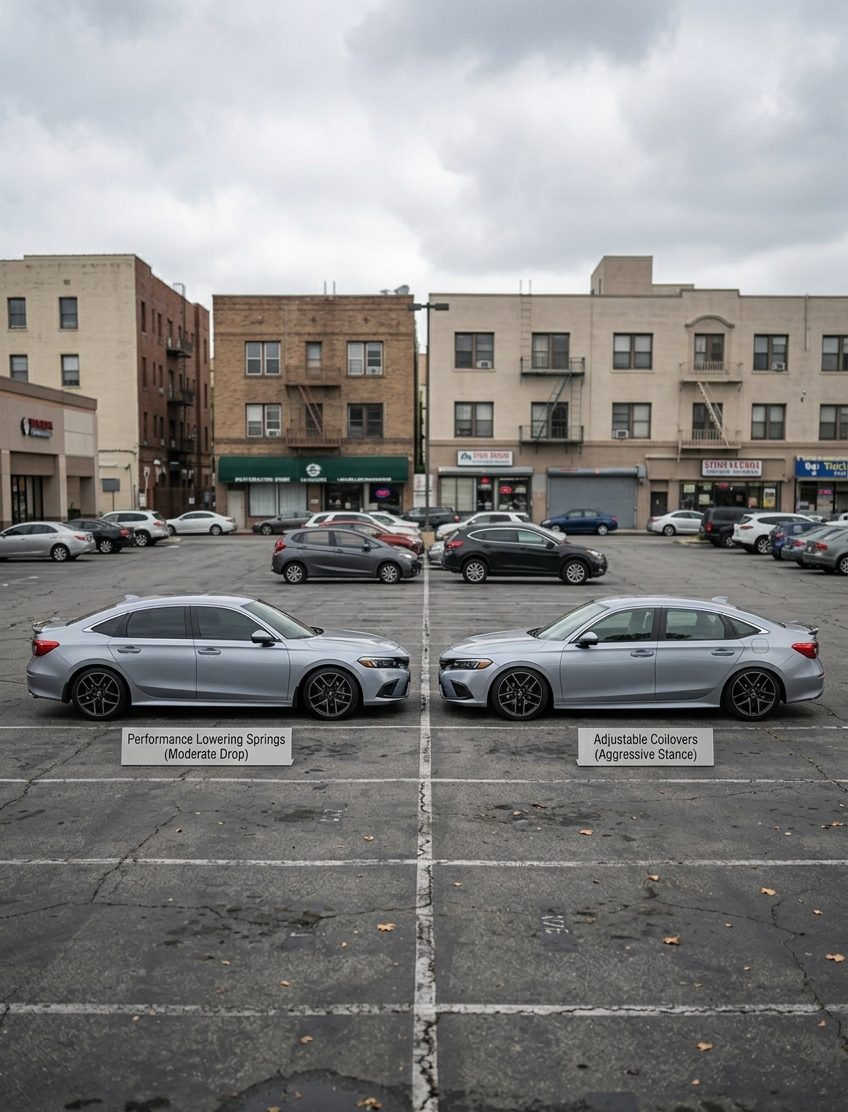
What's Different About This Decision on a Civic
The coilovers vs lowering springs decision plays out differently on a Civic than on many other platforms. The Civic has a few specific characteristics that affect which option makes more sense for different owners.
The Civic's MacPherson strut front suspension geometry is quite sensitive to ride height changes — more than most other compact cars. This means the alignment implications of lowering are more significant, and adjustability matters more than on a simpler suspension design.
Side by Side — Civic Specific
| Category | Coilovers | Lowering Springs |
|---|---|---|
| Price range | $400–$1,200 | $120–$350 |
| Ride height | Adjustable anytime | Fixed at install |
| Handling improvement | Significant | Moderate |
| Daily comfort | Tunable to your preference | Firmer, not adjustable |
| Alignment needs | Full alignment required | Full alignment required |
| CV joint stress | Manageable with correct height | Higher risk of premature wear |
| Best for Civic use | Enthusiast, track-adjacent, show | Mild street lowering on budget |
The CV Joint Problem — Civic Specific Warning
This is something that rarely gets discussed in generic coilovers vs springs comparisons but is very relevant to the Civic. The 10th gen Civic's front CV joints operate at increased angles when the car is lowered significantly. With lowering springs specifically, there's no way to adjust the ride height after install, which means if the springs lower the car more than expected for your specific configuration, the CV joints are under constant elevated stress.
Over time this causes premature CV joint wear and a clunking noise over bumps — a repair that costs more than the springs did. With coilovers you can raise the car if this becomes an issue. With springs you cannot.
Civic-specific recommendation: If you're choosing lowering springs for the 10th gen Civic, stick to springs with a maximum drop of 30–35mm (front) and avoid the cheapest options. Eibach Pro-Kit and H&R Sport Springs are the most commonly recommended for this platform — their drop figures are well within the Civic's safe zone.
Which One Is Right for Your Civic?
Choose coilovers if: You want adjustability, you drive your Civic enthusiastically, you might occasionally track it, or you care about getting the setup dialed in exactly right. Budget at least $450–$500 for a quality coilover kit — Rev9, BC Racing, or Fortune Auto are all solid choices with specific Civic tuning.
Choose lowering springs if: Budget is genuinely tight right now, you want a mild visual improvement and slightly better handling without complexity, and you're prepared to get a proper alignment. Just don't go cheap — spend at least $150 on springs from Eibach, H&R, or Tein.
Why the Civic Specifically Benefits from Getting This Right
The 10th and 11th gen Civic has a fundamentally good suspension platform — Honda engineers it to handle well from the factory, and the geometry responds predictably to modifications. This is good news because it means both coilovers and lowering springs can work well here, and the risk of making a genuinely bad choice is lower than on some other platforms. The question isn't really "which one won't ruin the car" — it's which one better matches how you actually use and maintain it.
The Si specifically deserves its own mention here. The limited-slip differential changes the conversation around suspension stiffness in a way that the standard Civic doesn't have. On a Si, a properly damped coilover allows the LSD to work more effectively under hard cornering because there's less body roll fighting the differential's effort to transfer torque. Lowering springs on a Si are still a valid choice, but you lose some of the handling benefit the LSD is supposed to provide when the damping is stock-rate.
What to Budget for Each Option
Lowering springs for the 10th gen Civic run $150-350 depending on brand. Eibach Pro-Kit sits around $250, H&R Sport around $200, and you'll find lesser-known options at the $150 mark that work but have less engineering behind them. Installation is $100-200 at most shops since it's not dramatically different from a standard shock replacement job. Alignment is mandatory — budget $100-150. Total landed cost: $400-700.
Entry-level coilovers start around $600 (Rev9, Godspeed) and scale up to $900 for BC Racing BR, $1,200 for Fortune Auto, $2,000+ for KW. Installation costs more than springs because there's more hardware involved — expect $150-250. Alignment is the same $100-150. Total landed cost: $850-2,500 depending on the kit.
The value comparison is clearest at the bottom of each range. Eibach springs for $250 installed and aligned for $600 total will genuinely outperform a $600 coilover kit from a no-name brand for daily driving, because the spring rate and damping match are better engineered. Don't buy the cheapest coilovers just to say you have coilovers.
The Alignment Conversation That Always Comes Up
Both options need a proper alignment after install. This isn't optional regardless of which route you choose — changing ride height changes camber and toe, and driving on misaligned suspension accelerates tire wear in ways that become expensive quickly. Find a shop that works with lowered Civics regularly rather than a generic tire shop that will just try to return everything to factory spec. The difference in how the car drives on a properly set alignment versus a lazy one is significant enough that it's worth being specific about when you book the appointment.
Frequently Asked Questions
Should I get coilovers or lowering springs for my Civic? Lowering springs are the better starting point for most Civic owners — cheaper, simpler install, and lower risk if you're new to suspension work. Coilovers make sense if you want adjustable ride height or plan to track the car.
Do lowering springs damage CV joints? Going too low with lowering springs alone (since they don't let you fine-tune height) can push CV axle angles outside their safe operating range, which accelerates wear. This is the CV joint warning worth taking seriously before dropping more than 1-1.5 inches.
Can I adjust ride height with lowering springs? No — lowering springs are a fixed drop, typically 1 to 1.5 inches depending on the brand. If you want adjustability, coilovers are the only option.
Which is cheaper, coilovers or lowering springs? Lowering springs are significantly cheaper, usually $150-300 versus $400-1500+ for coilovers, since you're keeping your stock shocks and just swapping the springs.
Bottom line for most Civic owners: Lowering springs if you want a clean daily with better looks and handling and don't want to think about adjustments. Coilovers if you want the ability to fine-tune ride height and damping, plan to track the car occasionally, or want to invest in a setup that lasts the life of the car with proper service. The price difference is real but so is the capability difference at equivalent quality tiers.
Can I run coilovers on a stock Civic daily driver? Yes — at moderate settings a quality coilover is perfectly liveable daily. The key is choosing the right spring rate and not going too low. Owners who report harsh rides have usually gone too aggressive on one or both of those.
How much drop do lowering springs give the Civic? Eibach Pro-Kit drops about 1 inch front and rear. H&R Sport drops about 1.2-1.4 inches. Tein S-Tech drops about 1.5 inches. More than 1.5 inches on springs gets into territory where the stock dampers struggle to control the spring properly.
Do lowering springs wear out stock shocks faster? Yes — running springs with a lower rate than the stock dampers were designed for accelerates wear on the dampers over time. How fast depends on how aggressive the springs are and how rough your roads are. Most owners get 40,000-60,000 miles from stock dampers on mild lowering springs before noticing degraded performance.
Can I switch from lowering springs to coilovers later? Yes, completely. Many owners start with springs and upgrade to coilovers later when budget allows. Nothing about running springs first prevents you from making the switch — you just need the full coilover install and a new alignment when you do.
What is the best lowering spring brand for the Civic? Eibach Pro-Kit is the most consistently recommended for a daily driver — predictable drop, good ride quality, available for most 10th and 11th gen applications. H&R Sport is a close second and slightly more aggressive. Both are significantly better than budget options from unknown brands that lack engineering data for the specific application.
Will lowering my Civic affect fuel economy? Marginally — a lower ride height slightly reduces aerodynamic drag which can improve highway fuel economy by a negligible amount. The bigger variable is tire size and wheel weight. Standard lowering spring setups have no meaningful impact on fuel economy in real-world driving.