Best Cold Air Intake for F150 5.0 Coyote — Ranked
The 5.0L Coyote responds to a cold air intake better than almost any other modern truck engine. Better throttle response, a dramatic induction sound, and real power gains — here is what each major brand actually delivers.
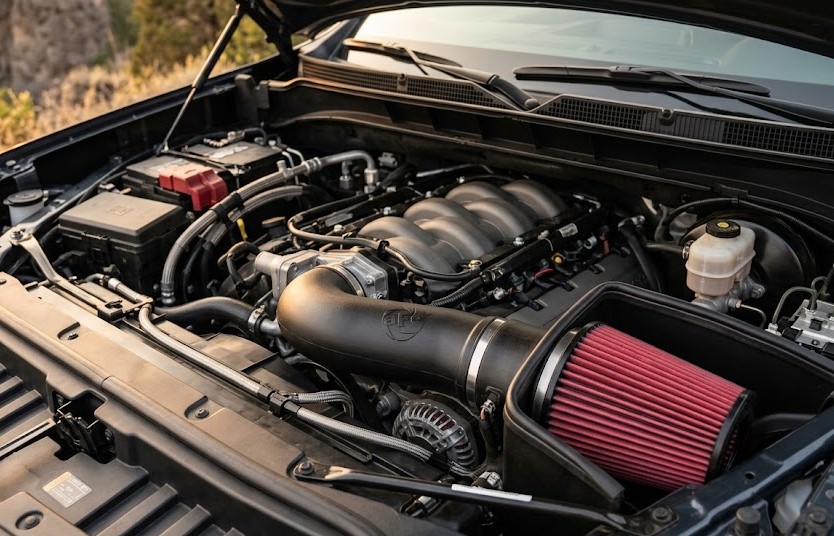
Why the 5.0L Coyote Benefits So Much From an Intake
Finding the best cold air intake for F-150 5.0 owners starts with understanding what the Coyote actually responds to. The naturally aspirated 5.0L Coyote is one of the few modern truck engines where a cold air intake delivers a genuinely dramatic improvement in driving character — not just a marginal performance number on a dyno sheet. Without a turbocharger between the air filter and the engine, every improvement in intake airflow and temperature translates directly to the engine's ability to make power on each intake stroke.
The factory airbox on the F150 5.0L prioritises noise suppression and packaging over flow. The result is a restricted inlet that significantly limits both the induction sound owners could be hearing and the airflow the Coyote is capable of processing. A quality cold air intake removes this restriction and lets the engine breathe as it was engineered to — the induction sound under full throttle is one of the most immediately satisfying improvements available on the 5.0L platform.
The power gains are real and measurable — cold air intake F150 gains on the 5.0L Coyote consistently measure typically 10-15 horsepower and 10-12 lb-ft of torque standalone, increasing to 20-25 horsepower with a supporting tune. More importantly, the throttle response improvement is felt immediately in daily driving — the engine feels sharper and more willing to rev from partial throttle in a way that makes the truck genuinely more enjoyable to drive.
Filter Type — Dry vs Oiled on the 5.0L
The 5.0L Coyote uses a Mass Air Flow sensor to measure incoming air and calculate fuel delivery. This makes filter type selection more important than on speed density tuned engines — an over-oiled filter can contaminate the MAF sensor and cause fault codes, rough idle, or hesitation that looks like an engine problem but is actually a filter maintenance issue.
Dry filter intakes (S&B, aFe Pro 5R) eliminate the oiling risk entirely — no oil to migrate to the MAF, no maintenance beyond periodic cleaning or replacement, and no contamination concern. This is why experienced F150 5.0L owners increasingly prefer dry filter systems over oiled alternatives.
Oiled filter intakes (K&N, Roush) work perfectly well when maintained correctly — the key word being correctly. Apply oil sparingly and evenly, allow it to absorb fully before installation, and never install an over-oiled filter. Done properly, oiled filters provide excellent filtration and good flow. The dry filter advantage is eliminating the possibility of doing it incorrectly.
Top Picks — Ranked for the 5.0L Coyote
Comparison Table
| Intake | Filter Type | Year Range | Best For |
|---|---|---|---|
| S&B Filters | Dry — enclosed box | 2018-2024 | Best all-round performance and heat isolation |
| K&N 57 Series | Oiled — open filter | Multiple years | Maximum induction sound |
| aFe Momentum GT | Dry — Pro 5R | 2021-2026 | Dry filter for 2021+ owners |
| Roush | Oiled | 2018-2025 | Ford-specialist premium option |
Do I Need a Tune With an Intake on the 5.0L?
Not required — the 5.0L's ECU handles the intake change within factory calibration limits and the truck runs cleanly without any additional work. Standalone gains of 10-15 horsepower are real and the throttle response improvement is immediately noticeable on the factory tune.
A tune becomes compelling when you also have an exhaust installed. With both intake and exhaust in place, a tune from Bama, SCT, or a custom dyno tune recalibrates the ECU around both modifications simultaneously — optimising air-fuel ratio, ignition timing, and throttle mapping for the improved inlet and outlet conditions. Combined intake-exhaust-tune packages on the 5.0L consistently show 25-35 horsepower over stock in documented dyno sessions.
Sound Improvement — What to Expect
The induction sound improvement on the 5.0L Coyote is one of the most compelling reasons to do this modification beyond the performance numbers. The factory airbox suppresses almost all induction noise — the engine is nearly silent at partial throttle and only slightly audible at full throttle. An aftermarket intake, particularly an open-filter design like the K&N 57 Series, transforms this completely.
Under full throttle acceleration the Coyote produces a distinctive induction roar that builds with RPM — a layered sound combining the mechanical character of the V8 and the rush of air through the filter. Combined with an aftermarket exhaust, the front induction noise and rear exhaust note create a driving experience that makes the 5.0L feel like a genuinely different truck than the factory-quiet version.
The 5.0L vs 3.5L EcoBoost — Which Benefits More From an Intake
Both the 5.0L Coyote and 3.5L EcoBoost respond well to cold air intake upgrades, but the character of the improvement differs meaningfully between the two engines. Understanding this helps set accurate expectations regardless of which engine your F150 has.
The naturally aspirated 5.0L benefits from an intake through direct airflow improvement — better flow means more air on each intake stroke, which directly translates to power and the dramatic induction sound improvement that makes the Coyote one of the best-sounding truck engines with an aftermarket intake installed. The sound transformation is immediate and significant — one of the most audibly rewarding modifications on any truck engine available today.
The turbocharged 3.5L EcoBoost benefits differently — improved airflow into the turbo compressor improves boost response and turbo efficiency, with the gains becoming more significant when a tune recalibrates boost targets around the improved inlet conditions. The sound improvement on the EcoBoost is present but more subtle than the 5.0L, since the turbocharger buffers the induction noise that the naturally aspirated Coyote produces so dramatically. EcoBoost owners typically choose their intake for performance gains and find the sound improvement a welcome bonus rather than the primary motivation.
Frequently Asked Questions
What is the best cold air intake for F150 5.0L? S&B for the best combination of performance, heat isolation, and dry filter convenience. K&N 57 Series for the best induction sound. aFe Momentum GT for 2021-2026 owners wanting dry filter technology. Roush for owners who want a Ford-specialist brand.
Will a cold air intake void my F150 warranty? Under Magnuson-Moss, Ford must prove the intake caused a specific failure to deny warranty coverage. A quality intake that does not damage the MAF sensor or create air leaks has minimal realistic warranty risk on unrelated systems.
Does S&B intake fit all F150 5.0L years? The S&B 75-5123-1 fits 2018-2024 F150 5.0L. Earlier and later model years use different part numbers — confirm your specific year before ordering.
How much power does a cold air intake add to F150 5.0L? 10-15 horsepower standalone on the stock tune. 25-35 horsepower combined with a cat-back exhaust and a supporting tune recalibrated around both modifications.
Dry filter vs oiled filter on F150 5.0L — which is better? Dry filter is the safer choice for MAF-equipped engines. Oiled filters work well when maintained correctly but the risk of MAF contamination from over-oiling makes dry filters the preference for most F150 5.0L owners.
How often does an S&B dry filter need cleaning? S&B recommends cleaning every 25,000-50,000 miles under normal conditions. No oiling required — wash with mild soap, air dry completely, reinstall.
Will a cold air intake improve F150 towing performance? Yes — improved throttle response and airflow makes the engine feel more capable under towing loads, particularly in the mid-range RPM where towing conditions live. Owners consistently report less frequent downshifting on grades and more confident sustained highway towing with a quality intake installed.