Best Cat-Back Exhaust for Silverado 5.3 — Ranked
The 5.3L EcoTec3 is one of the best sounding V8 truck engines when the factory exhaust gets out of the way. Here is exactly what each major system delivers and which one suits your build.
Why the 5.3L Responds So Well to a Cat-Back
Finding the best cat-back exhaust Silverado 5.3 owners actually want — and the best cat-back exhaust for a Silverado 5.3 build specifically — comes down to one decision above all others — sound level vs drone management. The 5.3L is a naturally aspirated V8, so an exhaust change can noticeably alter sound and character. The actual performance effect depends on the complete exhaust design, engine calibration and vehicle configuration; sound improvement should not be presented as proof of a measurable power gain. Unlike turbocharged engines where the turbocharger buffers the exhaust note, the 5.3L's sound travels directly from the exhaust ports through the system and out the tips — which means a quality cat-back produces a dramatic transformation in how the truck sounds, not just a subtle improvement.
The factory exhaust on the Silverado 1500 is engineered for noise suppression and emissions compliance. The muffler design and pipe diameter are conservative by performance standards, which is why the gap between stock and aftermarket is so noticeable on the 5.3L. An aftermarket cat-back replaces the restrictive factory muffler and typically upgrades to 3-inch or 3.5-inch piping, both of which improve exhaust flow and produce the V8 rumble the stock system deliberately suppresses.
One important complication is cylinder deactivation, but the terminology depends on model year and configuration. Older 5.3L applications use AFM, while many 2019-and-newer 5.3L trucks use DFM. That distinction matters when researching exhaust behavior and any related aftermarket device. AFM changes the exhaust pulse pattern significantly, and some aftermarket systems that sound excellent in eight-cylinder mode develop noticeable drone specifically during AFM operation. This is the most important factor to research before buying a 5.3L cat-back and the reason brand and system selection matters more on this platform than on simpler V8 applications.
2014-2018 vs 2019-2026 — Does It Matter for Exhaust?
Yes — and it matters more than most buyers realise. The 2019+ Silverado has a different exhaust routing, tip exit position, and in some configurations an active exhaust valve system that the 2014-2018 does not have. Do not assume systems from the 2014-2018 and 2019+ trucks interchange. Exhaust routing, tip position and equipment can differ by application, so confirm the exact year, cab/bed configuration and part number before purchasing — and be sceptical of listings that claim universal Silverado 1500 fitment without specifying generation.
The good news is that all four major brands covered in this guide offer generation-specific fitment. Borla, Corsa, MagnaFlow, and Flowmaster each have distinct part numbers for the two Silverado generations, and the affiliate links below are matched to the correct generation.
Top Picks — Ranked by Value and Real Owner Feedback
Sound and Drone Comparison
| System | Sound Level | Highway Drone | AFM Drone | Character |
|---|---|---|---|---|
| Stock | Quiet | None | None | Suppressed, refined |
| MagnaFlow Street | Moderate | Very Low | Low | Clean, refined V8 |
| Borla S-Type | Moderate-Loud | Low | Low | Deep, authoritative |
| Corsa Sport | Loud | Low | Low-Moderate | Aggressive, controlled |
| Flowmaster Outlaw | Very Loud | High | High | Aggressive, raw |
AFM, DFM and Sound Character
Cylinder deactivation can change exhaust pulse character on some 5.3L applications, but the experience depends on engine generation, cab, exhaust design and driving conditions. AFM and DFM are different GM systems, and neither should be presented as a universal failure risk or a guaranteed drone source.
Evaluate sound clips and owner feedback from the same application. Any device or tuning decision intended to alter cylinder-deactivation behavior can involve emissions, warranty and model-specific considerations; it is not a universal fix for every exhaust concern.
Performance Expectations
On a stock Silverado 5.3L, a cat-back is primarily a sound, appearance and fitment purchase. Exhaust flow can change, but measured results vary by the exact system, engine calibration, test conditions and supporting hardware. Avoid treating a quoted peak-horsepower number as a guaranteed result.
For towing, prioritize sound level, fitment and highway comfort over a small peak-number claim. Confirm the part number for the exact cab, bed length, drivetrain and model year before ordering.
Installation — What to Expect
The best cat-back exhaust for 5.3 Silverado builds is a bolt-on installation 1500 is achievable for a home mechanic comfortable with basic exhaust work in 2-3 hours. The system connects to the factory catalytic converter flange and uses the factory hanger positions. No welding required on quality bolt-on systems.
The most common installation challenge is seized hardware on older trucks — the factory bolts at the cat flange can be difficult to remove on trucks with significant mileage or exposure to road salt. Penetrating oil applied the day before makes this significantly easier. A second set of hands is useful for supporting the system weight while aligning it to the factory hangers.
Single vs Dual Exit — Which Looks and Sounds Better
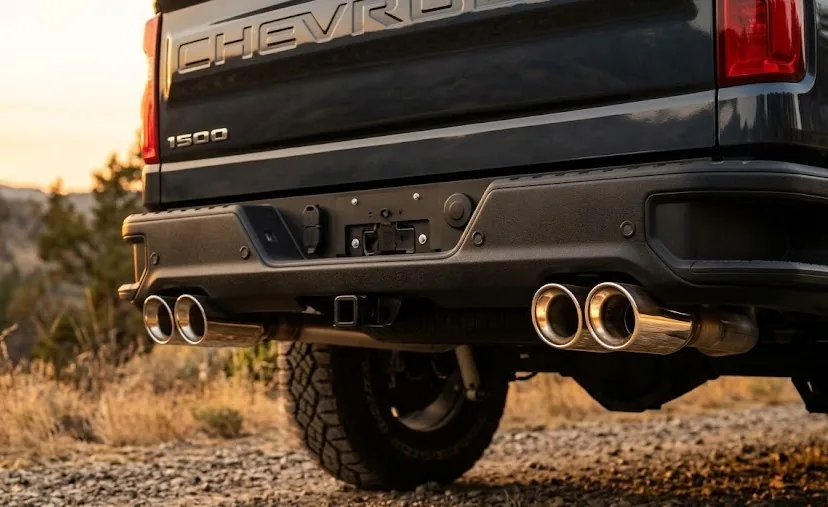
Most factory Silverado exhausts use a single offset exit on the passenger side. Aftermarket cat-back systems give you the choice between continuing with single exit or upgrading to dual exit — one tip on each side of the rear bumper. The visual transformation from single to dual exit is dramatic and is one of the most cited reasons owners choose specific systems beyond sound character alone.
Borla, Corsa, and MagnaFlow all offer dual exit configurations for the Silverado. The performance difference between single and dual exit at street power levels is negligible — the visual benefit is the real reason to choose dual, and it is a legitimate one. A Silverado with dual polished or black tips filling both sides of the rear bumper looks like an intentionally built truck rather than a stock truck with a muffler swap.
Side exit and turndown configurations are popular on lifted builds. Side exit directs exhaust downward or to the side rather than out the rear, which changes how the sound reflects off the ground and road surface. Drone characteristics can be unpredictable with side exit — some owners find it better than rear exit, others find it worse. If drone management is a priority, stick with a rear exit configuration from an established brand rather than experimenting with side exit on an aggressive chambered muffler.
Cat-Back Versus Axle-Back
A cat-back replaces the exhaust after the catalytic converter and usually includes the muffler, piping and tips. An axle-back replaces only the rear portion. The right choice depends on sound target, budget and whether the existing pipe condition justifies a full replacement. Both should be vehicle-specific for the correct cab, bed length, drivetrain and model year.
| Consideration | Cat-back | Axle-back or muffler |
|---|---|---|
| Coverage | More of the exhaust system | Rear section only |
| Cost and install | Usually higher and longer | Usually simpler |
| Sound tuning | Broader system change | Focused sound change |
For a tow vehicle or daily driver, select for highway comfort before maximum volume. Stainless material, factory hanger locations and accurate fitment are more useful than a generic promise of horsepower. See the 5.3L exhaust guide for use-case context.
Silverado 5.3L Cat-Back Buying Checklist
Do I need the same exhaust for every 5.3L Silverado?
No. Verify the exact model year and exhaust configuration. Connection points and routing can vary between generations and configurations even when the engine displacement is the same.
How should I judge sound from online videos?
Use videos to compare character rather than exact volume. Microphone placement, camera processing and environment change what you hear. Look for clips that include idle, cold start, acceleration and steady cruising.
Is a louder cat-back faster?
Not necessarily. Sound level and power output are different things. A cat-back can change the exhaust character substantially while producing a relatively modest peak-power change on a stock engine. Choose based on the sound and driving experience you actually want.
Frequently Asked Questions
What is the best cat-back exhaust for a Silverado 5.3L? Borla S-Type for the best balance of sound and drone management on a daily driver. Corsa Sport for maximum sound with better drone control than Flowmaster. MagnaFlow Street Series for the most refined daily driver improvement. Flowmaster Outlaw for maximum aggression if drone is acceptable.
Will a cat-back exhaust drone on a Silverado? Depends on the system. Borla and MagnaFlow are engineered to minimise drone. Corsa uses patented technology to manage drone at higher sound levels. Flowmaster Outlaw will drone noticeably, particularly during AFM four-cylinder operation. Sound behavior is system- and application-specific; no electronic device guarantees the same result on every exhaust or truck.
Does the 2014-2018 exhaust fit the 2019+ Silverado? Do not assume it does. Different routing, tip positions and equipment can require different applications, so verify the exact part number and configuration before purchasing.
Do I need a tune after a cat-back on the Silverado? Not required — the ECU handles the change within factory calibration. A tune after both intake and exhaust are installed extracts more performance by recalibrating around the hardware combination.
Should I get an AFM disabler with my Silverado exhaust? Some owners consider a device or calibration change, but the choice is engine- and jurisdiction-specific. It should not be treated as a universal cure for drone or a substitute for choosing an exhaust that suits the truck.rone after the fact.
How much does a Silverado cat-back cost installed? Quality systems run $500-900 for parts. Professional installation adds $150-250. Total landed cost: $650-1,150 depending on the system chosen.
Where to Go Next
If you are planning a Silverado build, use the guide that matches the decision you are making rather than jumping between unrelated upgrades.